
How Many Restrooms Does a County Fair Need?
Start with attendance, not acreage. A fairground pulling a few hundred people an hour needs far less than one running a midway at full capacity on a Saturday night. OSHA 1926.51(c) sets construction ratios at one toilet per 20 workers, and while a fair isn't a job site, organizers use similar per-head math scaled up for public events with food and drink. Our standard porta potty rental covers the bulk of a fairground, with deluxe flushable porta potty units placed near VIP areas or sponsor tents. Every standard unit carries a 60 to 70 gallon holding tank, built for the sustained traffic a fair generates over eight or ten hours a day, multiple days running.
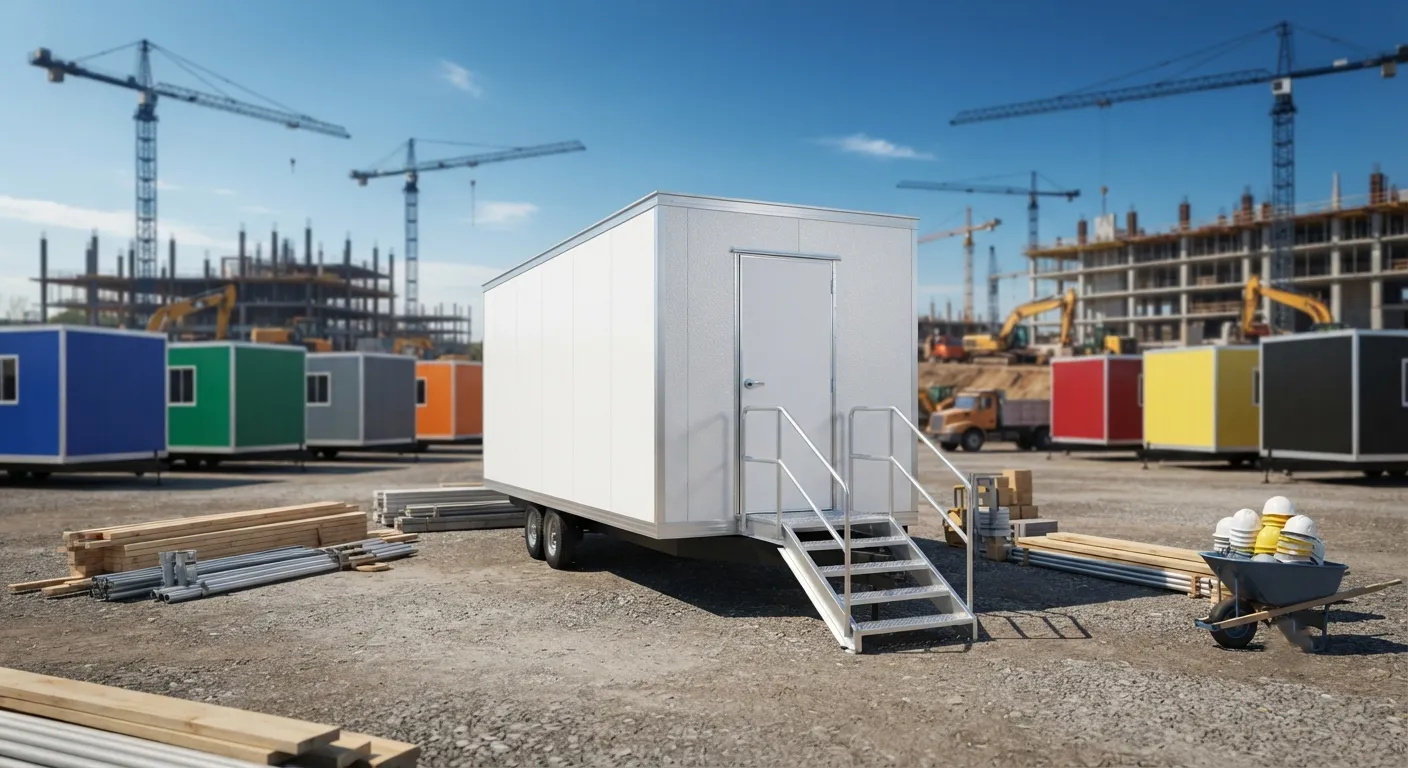
ADA Standards section 213.2 requires that at least 5 percent of a cluster of single-user toilets be accessible, with a minimum of one no matter how small the group. That means even a modest bank of ten units needs an accessible one worked into the layout, not tacked on at the end. Our ADA restroom requirements page walks through spacing and door clearance if your fair committee needs it in writing for a vendor packet. For fairs expecting heavier crowds across several zones, a restroom trailer rental or an 8 stall restroom trailer near the main stage cuts down long walks and line pileups.
Where Should Restrooms Go on a Fairground?
Cluster them at the edges of high-traffic zones, not buried behind vendor rows where nobody can find them. Place a set near the midway entrance, another near food courts, and a third near any grandstand or stage area if the fair runs a headline act. Our porta potty placement guide covers ground stability, since ADA Standards section 302.1 calls for firm, slip-resistant surfaces, which matters on grass fields that get soft after a watering truck passes or an afternoon sprinkle.
Delivery trucks need real space to maneuver. A roll-off or trailer delivery wants about 60 feet of straight clearance behind the truck, so fairground layouts built around tight access roads or fencerows can slow setup on move-in day. If your event footprint sits close to a public road, temporary fencing helps route foot traffic away from delivery lanes. Our temporary fence rental and crowd control barrier rental both work well for staging a safe delivery corridor while gates are still closed to the public. North Tustin sits about 3.1 miles north of Tustin, and Placentia is roughly 12.6 miles north, both close enough that we stage trucks locally rather than routing them across the county on fair morning.
Handwashing matters as much as toilet count once food vendors set up. 29 CFR 1910.141(d)(2) requires soap and towels or a hand drying device at wash stations, and hand sanitizer alone doesn't satisfy that. Pair our handwashing station rental with your restroom cluster, especially near funnel cake stands and barbecue trailers where hands get greasy fast. If a booth runs food prep involving grease, a nearby grease trap pumping service keeps things from backing up mid-event, since grease interceptors need pumping once fats, oils and solids hit 25 percent of liquid depth.
What Does a County Fair Restroom Package Cost?
Pricing scales with unit type and how many days the fair runs. Multi-day fairs usually land on event-rate pricing rather than daily, since crews are cleaning and restocking through the run rather than doing a single drop and pickup.
| Unit | Day | Week | Event |
|---|---|---|---|
| Standard unit | $100-$350 | $130-$500 | $200-$800 |
| ADA unit | $200-$400 | $240-$400 | -- |
| Restroom trailer | $175-$2,500 | $1,650-$2,500 | $2,499-$3,899 |
Delivery fees run separately, typically $100 to $500 for a single delivery depending on distance and access. Full details on how these numbers break down live on our porta potty rental cost and restroom trailer rental cost pages. For fairs booked well ahead, our request a quote form lets a committee lock in unit counts before the vendor deadline hits.
Lighting matters for evening fair hours. OSHA 1926.56(a) sets minimum illumination levels for work areas, and while a fairground isn't a construction site, the same logic applies to keeping restroom paths lit after dark. A light tower rental near restroom clusters cuts down on complaints and keeps foot traffic moving safely once the sun goes down.
How far in advance should we book fair restrooms?
Book six to eight weeks out if possible, especially for multi-day fairs needing trailers rather than standard units. Restroom trailers in particular have limited local inventory, and event-rate bookings fill fast during peak fair season in Southern California.
Do we need ADA units even for a small fair?
Yes. ADA Standards section 213.2 requires at least one accessible unit in any cluster, with no exceptions for smaller events. Skipping it risks complaints and puts your fair out of compliance with basic accessibility standards.
Can Tustin Porta Pros service restrooms during multi-day events?
Yes, servicing is built into event-rate pricing. Crews return daily or as scheduled to pump tanks, restock supplies and clean units, similar to the weekly baseline described in ANSI/PSAI Z4.3 for lower-traffic settings, scaled up for fair-level use.
What if our fairground has no paved access roads?
We still need roughly 60 feet of straight clearance for delivery trucks. Grass and dirt lots work fine if they're stable and dry; call ahead if recent rain has softened the ground.
Does a county fair need handwashing stations separate from restrooms?
Yes, especially near food vendors. 29 CFR 1910.141(d)(2) requires soap and towel access, which standalone handwashing stations provide better than sink-equipped restroom units alone during high food traffic hours.
Next step
Get a delivery date
Tell us the address, the dates and the headcount. We size the order and confirm the route.